
Liverpool in the 1990s was the city that never slept – home to one of the most influential and dynamic nightlife scenes in the country. Legendary clubs like Cream, The 051, Club Continental, Paradox and The Grafton opened to buzzing crowds eager to drink and dance the night away.
 But behind the bright lights and pulsating music, an underworld menace hid in plain sight on the doors of the very nightclubs they claimed to protect. With the rise of hard drugs in Liverpool over the previous decade, there was money to be made by controlling the doors of city nightclubs, through which a lot of the drugs and money flowed.
The tough but fair “dickybow doormen” of the 70s faded into memory as new firms of hardened street toughs manouevred themselves into positions where they could control the lucrative trade.
Burly bouncers were hand-picked from gyms and boxing clubs; others were ex-cons with a penchant for violence. As competition mounted between Liverpool’s most popular pubs and clubs, rivalries flared and tempers frayed.
By the early 1990s, the “door wars” had reached a deadly apex. The security industry had become a gangland with links to organised crime, and bouncers were often regarded as little more than hired thugs.
Stephen Cole, a former Liverpool FC reserve player, was an active participant, and no stranger to violence. He had previously been acquitted of trying to shoot a rival bouncer.
In 1996, he was a firm fixture at the popular Cream nightclub in Wolstenholme Square. Described as a “Jekyll and Hyde” character, at home Cole was a loving and good-humored husband and dad. On the door he was violent, intimidating, and a looming figure in the murky world of nightclub security.

Animosity had been bubbling for some time between Cole’s friend and fellow doorman Chitton Jenkins and another man, John Dillon, who worked at the Continental. On May 12 1996, at the Brubaker’s Club in Kirkby, Jenkins stabbed Dillon – who survived the ordeal.
The tension ramped up further on May 18, when there was a stand-off between two groups of bouncers in Wolstenhome Square, Cream on one side and the Continental on the other.
After hollering threats at Dillon, Cole decided to take matters into his own hands. On May 19, police received a tip-off that Cole intended to shoot the other man in cold blood.
Dillon, however, refused an offer of police protection. Within a few hours, he had placed more than 60 calls to other doormen as he orchestrated a hit of his own.
At around 9pm that night, around 40 bouncers gathered outside Gino’s wine bar in Kirkby. They set off in a convoy, with four to five large men in each car, visiting both the Copplehouse pub and the Chaser, where police officers who had been following them lost their trail.
The angry mob headed straight for the Farmer’s Arms in Fazakerley, where Cole, his wife Lorraine, and two friends were enjoying a drink.
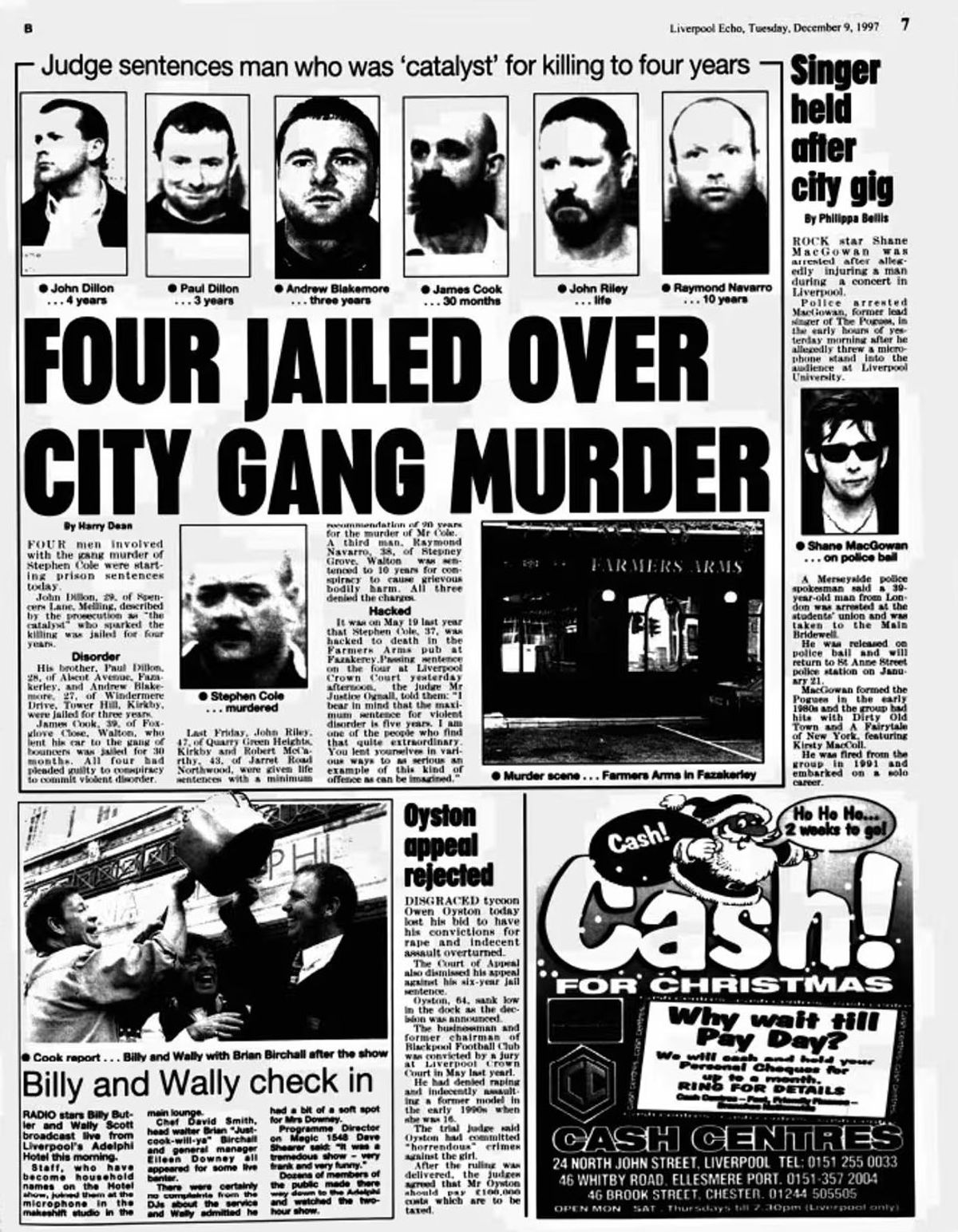
At around 10pm on May 19 1996, the crowded Farmer’s Arms pub exploded in a crescendo of bloody violence. Around 20 bouncers, mostly from the Continental, burst through the doors and rushed into the lounge, knocking security aside as they honed in on their target.
Armed with machetes, baseball bats and knives, the gang descended on Stephen Cole. Still, the once-feared kingpin refused to go down without a fight. Rising to his feet, he beckoned one of the men forward and said: “Come on. Have a go if you think you can do it.”
No sooner had he knocked the other man to the ground, he was swarmed by the baying mob. He stood no chance as he was “hacked to death” in front of his wife, who recoiled in horror as she recognised one of the attackers as 47-year-old John Riley, a long-time family friend.

Riley had known the Coles for 17 years and had attended their wedding and the christenings of their two children. Now he was at the forefront of the slaughter, which left Cole with 13 wounds to his skull, torso and legs.
Screaming and crying, Lorraine Cole asked Riley: “What are you doing this for?”
Riley replied: “That’s for what he’s done, that’s for the stabbing.”
Riley, of Quarry Green Heights in Kirkby, was charged with the murder, as was 43-year-old Robert McCarthy, of Jarret Road, Northwood. Together they were said to have led the attack on Stephen Cole.
Both pleaded not guilty, and a trial began at Preston Crown Court in November 1997. Preceding the trial, a range of threats were used to silence witnesses, including petrol bombings, threatening telephone calls, poison pen letters, vandalism and verbal abuse.
Several dozen people were drinking in the Farmer’s Arms at the time of the attack, but only a few admitted to seeing anything. Several witnesses gave evidence only after warrants had been issued ordering them to attend the court.
Det Supt Russ Walsh, who led the murder investigation, told the ECHO: “The deceased’s relatives have had a very difficult time and one witness had his house and car petrol-bombed, while another had his car tyres and soft-top roof slashed.
“One woman who was not even a witness, just a family friend of the Coles was also threatened. This is just an example of what was going on.
“There is obviously a fear factor involved when you see something so brutal and horrific. Especially when it involves so many well-built muscular types who thought they could do exactly what they wanted and no-one would do anything.”
Despite this campaign of terror, Stephen’s wife Lorraine Cole became the star witness. She told Preston Crown Court of “her horror as John Riley repeatedly hacked at Stephen Cole’s body with a weapon as she cradled her dying husband in her arms” (Liverpool ECHO, November 20 1997).
She said: “I bent down to help Steve. When I looked up John Riley was looking at me. I was screaming and crying and saying ‘John, what are you doing this for?'”
Riley, a rival bouncer, and McCarthy were both found guilty of murder and were jailed for life with a recommended minimum of 20 years. A third man, Ray Navarro, 38, of Stepney Grove in Walton, was found guilty of grievous bodily harm and sentenced to 10 years.
Dillon, then 29, later admitted conspiracy to commit violent disorder and was jailed for four years alongside several other men. Justice Ognall described him as the “catalyst” and “prime mover” of the attack. He said: “I bear in mind that the maximum sentence for violent disorder is five years. I am one of the people who find that quite extraordinary.
“You lent yourselves in various ways to as serious an example of this kind of offence as can be imagined”.
In the 1990s many Liverpool crime gangs were either directly or indirectly linked to door firms. The promise of a better future began in 2001, when the Security Industry Authority was formed. The regulatory body stops serious criminals from controlling security companies and from working on doors.
But it was a vicious terror campaign, waged by a drugs gang known as The Piranhas, that eventually turned the tide in Liverpool. After being turned out of a number of clubs and pubs, the gang planted a series of car bombs all over the city.
The first massive car bomb went off outside the famous 051 nightclub on Mount Pleasant, which resulted in widespread damage. When police investigated, the car bombs were planted outside police stations instead.
The car bomb campaign was seen as a new low by many people working in Liverpool’s security industry.
The scale of the violence also led to a change in mindset, with security bosses and senior doormen becoming far more willing to cooperate with the police.
John Dillon, whose stabbing was arguably the catalyst in Stephen Cole’s murder, left the security service and later became a combat coach at Kirkby Amateur Boxing Club.
In September 2023, the 55-year-old was unmasked as an organised crime boss importing millions of pounds worth of cocaine sourced from drug cartels in Europe and Colombia. He used the EncroChat encrypted phone network to evade police until detectives from the North West Regional Organised Crime Unit (NWROCU) linked him to the handle “DeepOasis”.
Analysis of Dillon’s messages showed the sale of more than 100kg was organised through EncroChat, with photographs of illegal substances shared before a price was agreed. Dillion would even cycle miles at a time during lockdown to evade police, to deliver drug money to his associates.
Dillon was jailed for 18 years and nine months at Liverpool Crown Court on September 28 2023 after pleading guilty to conspiracy to import and supply Class A drugs.
Source – Liverpool Echo