
Conflict happens everywhere—in workplaces, schools, healthcare settings, and even at home. When emotions run high and tensions escalate, having effective deescalation techniques in your toolkit can mean the difference between resolution and chaos. These evidence-based strategies don’t just calm heated situations; they preserve relationships and create opportunities for genuine understanding.
Research shows that skilled deescalation can reduce workplace conflicts by up to 60% and significantly decrease the need for more intensive interventions. Whether you’re a manager dealing with frustrated employees, a teacher managing classroom disruptions, or simply someone who wants to handle difficult conversations better, mastering these techniques will transform how you navigate challenging interactions.
The following ten deescalation strategies are grounded in psychology and have been refined through years of practical application across various professional settings. Each technique addresses different aspects of human behaviour during crisis moments, from emotional regulation to communication dynamics.
Why De-escalation Matters More Than Ever
Effective deescalation isn’t just about stopping arguments—it’s about creating pathways to resolution that leave everyone’s dignity intact. When conflicts escalate, rational thinking decreases while emotional reactivity increases. This creates a perfect storm where misunderstandings multiply and positions become entrenched.
Professional settings increasingly recognise that reactive approaches to conflict management often backfire. Traditional authoritarian responses can trigger defensive reactions, making situations worse rather than better. Modern deescalation strategies focus on understanding underlying needs and emotions rather than simply suppressing problematic behaviours.
The cost of unresolved conflict extends far beyond the immediate situation. Workplace disputes can lead to decreased productivity, higher staff turnover, and damaged team dynamics. In educational settings, poorly handled behavioural incidents can impact learning environments for entire classes. Healthcare conflicts can compromise patient safety and staff wellbeing.
Top 10 De-escalation Techniques
1. Be Empathetic and Nonjudgemental
The foundation of successful deescalation lies in genuine empathy. When someone is distressed, their feelings are real and valid to them, regardless of whether you believe those feelings are justified. Dismissing or minimising their emotional experience will only escalate the situation further.
Active empathy involves more than just listening—it requires recognising the emotional weight of what someone is experiencing. Instead of saying “that’s not a big deal,” try “I can see this is really important to you.” This simple shift acknowledges their reality without necessarily agreeing with their perspective.
Avoid making judgements about the person’s character or behaviour during heated moments. Focus on understanding their underlying concerns rather than evaluating whether their response is appropriate. Remember that what seems like an overreaction might be the result of accumulated stress or past experiences you’re not aware of.
2. Respect Personal Space
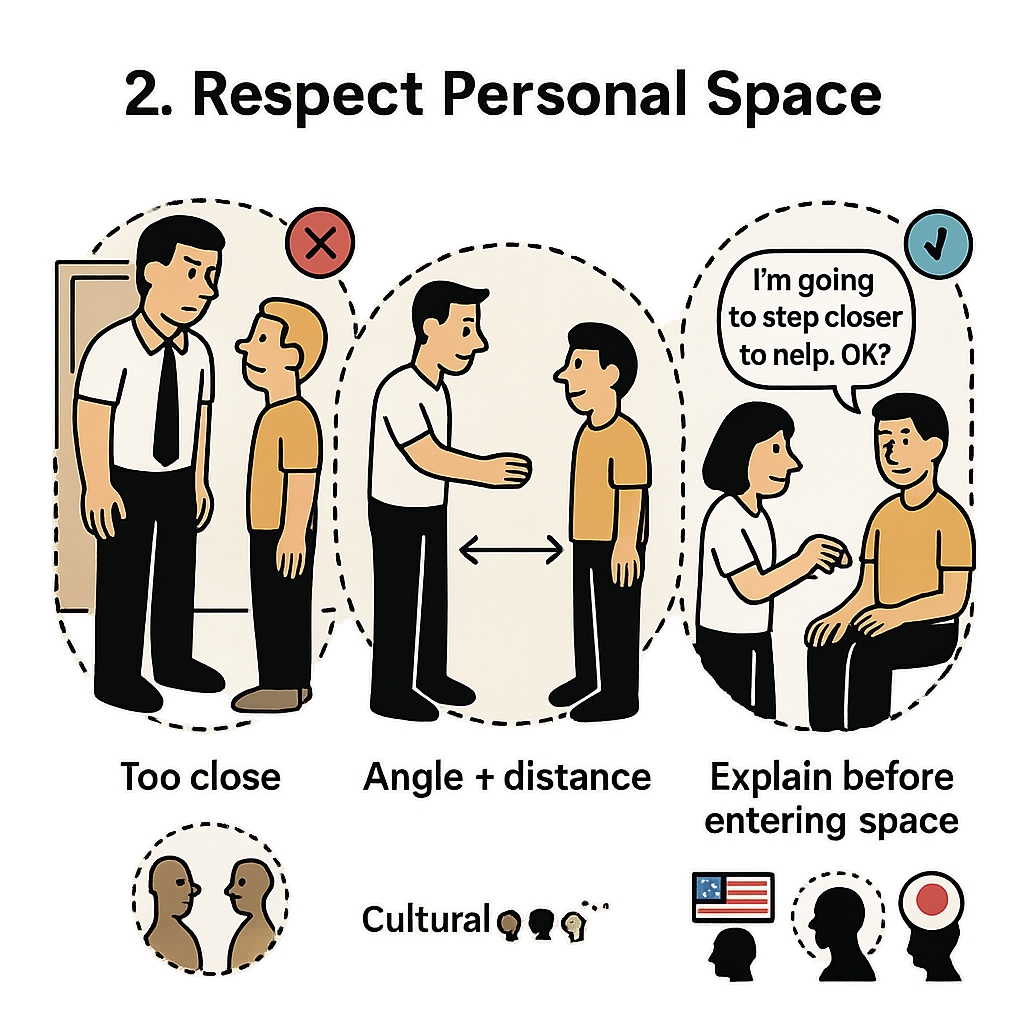 Physical proximity can significantly impact how safe someone feels during a conflict. Personal space extends 360 degrees around a person, including above and below. Towering over someone, blocking exits, or standing too close can trigger fight-or-flight responses that make deescalation nearly impossible.
Be mindful of your positioning during tense interactions. Standing at an angle rather than directly facing someone can feel less confrontational. Maintaining appropriate distance shows respect while keeping you safer. If you must enter someone’s personal space to provide assistance, explain what you’re doing so they feel less confused or threatened.
Cultural differences in personal space preferences add another layer of complexity. What feels comfortable to one person might feel invasive to another. Observe nonverbal cues and adjust accordingly—if someone steps back, don’t follow. Give them the space they need to feel secure.
3. Use Nonthreatening Nonverbals
 When emotions run high, people become less responsive to words and more reactive to nonverbal communication. Your body language, facial expressions, gestures, and tone of voice carry more weight than your actual words during crisis moments.
Maintain neutral facial expressions and avoid aggressive gestures like pointing or crossed arms. Keep your hands visible and use open palm gestures when appropriate. Your tone of voice should remain calm and steady, even if the other person is shouting. Speaking slowly and quietly often encourages others to lower their volume as well.
Movement patterns matter too. Sudden or jerky movements can be perceived as threatening. Smooth, deliberate actions signal control and safety. Make eye contact appropriately—enough to show engagement without staring, which can feel challenging or intimidating.
4. Keep Your Emotional Brain in Check
Your emotional state directly influences the other person’s emotional state through a process called emotional contagion. If you become agitated, frustrated, or defensive, these emotions will likely spread to the other person, escalating the situation further.
Maintain internal calm by using positive self-talk like “I can handle this” or “I know what to do.” Focus on your breathing to prevent your own stress response from kicking in. Remember that you can’t control the other person’s behaviour, but you have complete control over your own response.
Professional detachment doesn’t mean being cold or uncaring—it means maintaining enough emotional distance to think clearly and respond strategically. This requires practice and self-awareness. Recognise your own triggers and develop strategies to manage them before they compromise your effectiveness.
5. Focus on Feelings
Facts matter, but feelings drive behaviour during conflicts. Someone might be arguing about policies or procedures when they’re actually feeling unheard, disrespected, or powerless. Addressing the underlying emotions is often more effective than debating the surface-level issues.
Listen for the emotional content beneath the words. If someone is complaining about unfair treatment, they might be feeling frustrated or marginalised. Acknowledge these feelings with statements like “It sounds like you’re feeling frustrated about how this was handled” or “That must have been disappointing for you.”
Some people struggle to identify or articulate their emotions, especially during stressful situations. Help them by reflecting what you observe: “I notice you seem upset about this” or “This situation appears to be causing you some anxiety.” This validation can help them feel understood and begin to process their emotions more constructively.
6. Ignore Challenging Questions
When people feel cornered or defensive, they often resort to challenging your authority or competence. Questions like “Who do you think you are?” or “What gives you the right?” are designed to shift focus away from the real issue and onto a power struggle.
Don’t take the bait. These challenges are rarely about you personally—they’re expressions of frustration or attempts to regain control. Instead of defending yourself or your authority, redirect attention back to the underlying concerns. Acknowledge the challenge without engaging: “I understand you’re upset. Let’s focus on what we can do to address your concerns.”
Your ego doesn’t need to enter the conversation. Stay focused on problem-solving rather than proving your credibility. Often, demonstrating competence through your actions is more effective than arguing about your qualifications or authority.
7. Set Limits
Clear, respectful boundaries are essential for effective deescalation. When someone’s behaviour becomes inappropriate—whether through aggression, abusive language, or disruptive actions—they need to understand the limits of acceptable conduct.
Offer simple, respectful choices with clear consequences. For example: “I want to help you resolve this issue, but I need you to lower your voice so we can have a productive conversation. If you continue shouting, I’ll need to end this meeting and we’ll need to schedule another time to discuss this.”
Make sure your limits are enforceable and reasonable. Don’t threaten consequences you can’t or won’t follow through on. The goal is to create structure that allows for constructive dialogue, not to punish or control the other person.
8. Choose Wisely What You Insist Upon
Not every rule needs to be enforced with equal rigidity during a crisis. Distinguish between negotiable preferences and non-negotiable safety requirements. Flexibility on minor issues can prevent unnecessary conflicts while maintaining firm boundaries around essential matters.
Ask yourself: “Is this worth escalating over?” Sometimes allowing someone to save face by offering alternatives can resolve the situation more effectively than rigid adherence to procedures. If someone doesn’t want to sit in a particular chair or follow a specific sequence of steps, consider whether accommodation is possible without compromising important objectives.
Strategic flexibility demonstrates reasonableness and can de-escalate situations by giving people some sense of control or choice within the constraints of the situation.
9. Allow Silence for Reflection
Silence can feel uncomfortable, but it serves important functions during deescalation. Moments of quiet give people time to process what’s been said, regulate their emotions, and consider their response. Rushing to fill every pause with words can prevent this natural processing from occurring.
Use silence strategically. After making an important point or asking a significant question, give the other person time to absorb and respond. This shows respect for their thinking process and reduces the pressure they might feel to react immediately.
Comfortable silence also models calm behaviour. If you can remain relaxed during quiet moments, it demonstrates that you’re not anxious or rushed, which can help the other person feel more at ease as well.
10. Allow Time for Decisions
Stress impairs decision-making capacity. When people feel pressured to respond immediately, their stress levels increase and their ability to think clearly decreases. Providing adequate time for consideration can lead to better outcomes for everyone involved.
Explicitly give people permission to take time: “Take a moment to think about this” or “There’s no rush—what feels right to you?” This reduces the pressure they might feel to respond defensively or reactively.
Time pressure often leads to poor decisions that need to be revisited later. Investing a few extra minutes in thoughtful decision-making can save hours of dealing with the consequences of rushed choices.
Additional De-escalation Strategies
Beyond these core techniques, several supplementary approaches can enhance your deescalation effectiveness. Environmental factors play a crucial role—removing potential weapons, adjusting lighting, or changing locations can all influence the dynamics of a difficult situation.
Consider the timing of interventions. Early intervention during the trigger phase is more effective than attempting deescalation when someone is already in full crisis mode. Learn to recognise the warning signs that indicate someone is becoming agitated, such as changes in voice tone, body language, or facial expressions.
Documentation and follow-up are often overlooked aspects of deescalation. Recording what techniques worked (and which didn’t) helps build a knowledge base for future situations. Following up with individuals after conflicts shows ongoing care and helps prevent similar issues from recurring.
The Importance of Proactive Strategies
The most effective deescalation happens before conflicts reach crisis level. Proactive strategies focus on creating environments that minimise the likelihood of escalation in the first place. This includes clear communication of expectations, consistent policies, and regular check-ins with individuals who might be experiencing stress.
Training and preparation are essential. Like any skill, deescalation improves with practice. Role-playing exercises, scenario discussions, and regular refresher training help build confidence and competence. When people feel prepared to handle difficult situations, they’re less likely to react defensively or escalate conflicts inadvertently.
Building positive relationships before conflicts arise creates a foundation of trust that makes deescalation more effective. When people believe you genuinely care about their wellbeing, they’re more likely to accept your attempts to help during difficult moments.
Mastering the Art of Deescalation
Effective deescalation is both an art and a science. While these techniques provide a solid framework, successful application requires adapting to individual situations, cultural contexts, and personal dynamics. The goal isn’t to eliminate all conflict—some disagreement is natural and even healthy—but to manage it constructively.
Practice these techniques regularly, starting with low-stakes situations. Build your confidence and skills gradually rather than waiting for high-pressure moments to test new approaches. Seek feedback from colleagues and continuously refine your approach based on what works in your specific environment.
Remember that deescalation success isn’t always measured by immediate resolution. Sometimes, the best outcome is preventing a situation from getting worse while creating space for future problem-solving. Every positive interaction, even during conflict, contributes to building trust and improving relationships over time.
The investment in learning these skills pays dividends far beyond avoiding immediate problems. Organisations with strong deescalation capabilities report better staff morale, improved customer satisfaction, and more positive workplace cultures. On a personal level, these skills enhance your ability to navigate all kinds of challenging relationships and situations with greater confidence and success.